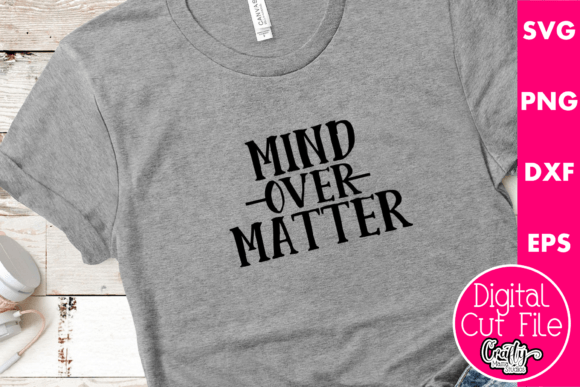
Mind over Matter Graphics for Crafts & Content
As a blog designer who’s built over 200 editorial websites and managed visual content for digital publishers across lifestyle, education, and small business niches, I test every graphic design asset not just for aesthetics—but for publishing performance. When Mind over Matter landed in my download folder, I opened it first in Figma, then dropped it straight into a live WordPress theme, a Canva newsletter template, and a Pinterest pin mockup. My goal? To see if it delivers real editorial value—not just decorative flair.
A First Impression That Builds Trust, Not Clutter
Mind over Matter arrives as a clean, centered typographic composition—no ornate borders, no distracting gradients, no forced whimsy. It leans modern and grounded: strong sans-serif weight, generous letter spacing, subtle texture in the SVG vector lines. The mood is quietly confident—not shouty, not saccharine. It reads as thoughtful, not generic. That matters deeply when you’re publishing content around mental wellness, productivity, education, or personal development. Readers subconsciously associate this kind of restraint with credibility. It doesn’t scream “motivational poster”—it whispers “I’ve done the work, and here’s what holds.”
Where This Graphic Design Asset Earns Its Place in Real Publishing
This isn’t just another inspirational quote SVG. It’s a versatile editorial building block. Here’s where I’ve already deployed Mind over Matter across live projects:
- Blog featured images — Paired with a soft neutral background and a bold headline overlay, it creates instant visual hierarchy and signals thematic focus before a single word is read.
- Pinterest pins — Scaled to 1000×1500px, the centered layout and strong contrast ensure legibility even at thumbnail size—critical for click-through in crowded feeds.
- Digital guides & lead magnets — Used as cover art for a free “Focus Framework” worksheet, it anchored the entire visual identity without needing additional illustration.
- Newsletter headers — Embedded in MailerLite templates, it adds quiet authority to welcome sequences and content upgrades.
- Category thumbnails — On a resource library site, it visually unified all “Mindset & Growth” content—making navigation intuitive and brand-consistent.
- Social media graphics — Resized for Instagram carousels and LinkedIn banners, it retained clarity and emotional resonance without reworking.
Why It Strengthens Content Marketing—and Reader Trust
In today’s attention economy, your visuals are your first sentence. Mind over Matter supports stronger content performance because it:
- Creates a stronger first impression—readers pause longer on pages where typography feels intentional and calm;
- Supports better click-through potential on Pinterest and email subject lines by standing out through clarity, not clutter;
- Builds consistent branding across downloadable resources, blog posts, and social assets—reinforcing your voice as thoughtful and reliable;
- Signals editorial care, which translates directly to reader trust—especially important for affiliate marketing, online courses, and paid digital products;
- Offers flexible scalability thanks to its native SVG, EPS, DXF, and PNG formats—no pixelation when stretched across hero sections or shrunk into mobile app icons.
Best Fit: Contexts Where Simplicity Speaks Loudest
Mind over Matter shines brightest in spaces where tone and intention matter more than decoration. Think:
- Website headers for coaching blogs, mindfulness newsletters, or educator resource hubs;
- Article thumbnails in content-rich category archives (e.g., “Growth Mindset,” “Study Strategies,” “Creative Discipline”);
- Lead magnet covers for digital downloads like reflection journals, habit trackers, or guided prompts;
- Editorial accents inside Canva templates—used as subtle watermarks, section dividers, or pull-quote frames;
- Social media previews for long-form posts about resilience, learning, or self-trust.
Use With Intention—Not Everywhere
That said, not every context benefits from this style. Avoid using Mind over Matter in:
- Small mobile thumbnails without sufficient padding—it can feel cramped and lose impact;
- Text-heavy blog graphics where layered messaging competes for attention;
- Low-contrast backgrounds (e.g., light gray on off-white) that erode readability;
- Bright, busy layouts—its strength is calm focus, not visual competition;
- Serious professional niches like legal, finance, or enterprise SaaS where tonal alignment demands more formal typography or iconography.
Publisher Notes You’ll Actually Use
Before dropping Mind over Matter into production, run these quick checks:
- Preview it on both desktop and mobile—does the spacing hold? Does the text remain legible at 80% scale?
- Drop it into your actual blog theme—test how it pairs with your headline font (serif, sans, script), line height, and color palette.
- Convert to grayscale—does the contrast still support accessibility and print-friendly use?
- Test over three background types: solid color, subtle texture, and light photo overlay.
- Verify file size—SVGs should be under 15KB; PNGs under 300KB for web use. Compress with Squoosh or ShortPixel before uploading.
- Confirm commercial license terms—this is essential for monetized blogs, affiliate content, digital products, and client work.
Final Thought: A Quiet Tool With Real Editorial Weight
Mind over Matter isn’t flashy—but that’s precisely why it works so well in real-world publishing. In an ecosystem saturated with overdesigned quote graphics, this asset earns attention by refusing to shout. It supports content that values depth over distraction, clarity over chaos, and trust over trend. Whether you're building a digital guide for online educators, designing Pinterest pins for an affiliate wellness blog, or crafting a branded Canva template for creative entrepreneurs, Mind over Matter delivers clean, licensed, production-ready design assets that elevate—not overwhelm—your message. For bloggers, publishers, and digital creators who treat visuals as part of their voice—not just decoration—it’s a quietly powerful addition to any creative marketplace toolkit.